No, you do not need experience before hiring a private boxing coach. A beginner-focused coach teaches stance, footwork, punching mechanics, and defense from the ground up; you do not need to learn combinations first. The important distinction is between learning boxing technique and preparing for contact: hiring a coach does not mean you are ready to spar.
- Do you need experience before hiring a boxing coach? No—beginner instruction starts with stance, footwork, and punching mechanics.
- Better Through Boxing offers live private boxing coaching for beginners through competitors, including lessons via Zoom.
- Choose instruction that corrects your technique, not just a workout that leaves you tired.
- Treat sparring as a separate decision, not a requirement for starting private boxing lessons.
Do you need experience before hiring a private boxing coach?
You need a coach willing to teach beginners, not boxing experience. Your starting point tells the coach what to teach. It is not an entrance requirement.
For your first booking in 2026, describe your experience honestly: never trained, tried fitness boxing, practiced alone, or taken previous lessons. Those backgrounds are different. None replaces an assessment of how you stand, move, and punch.
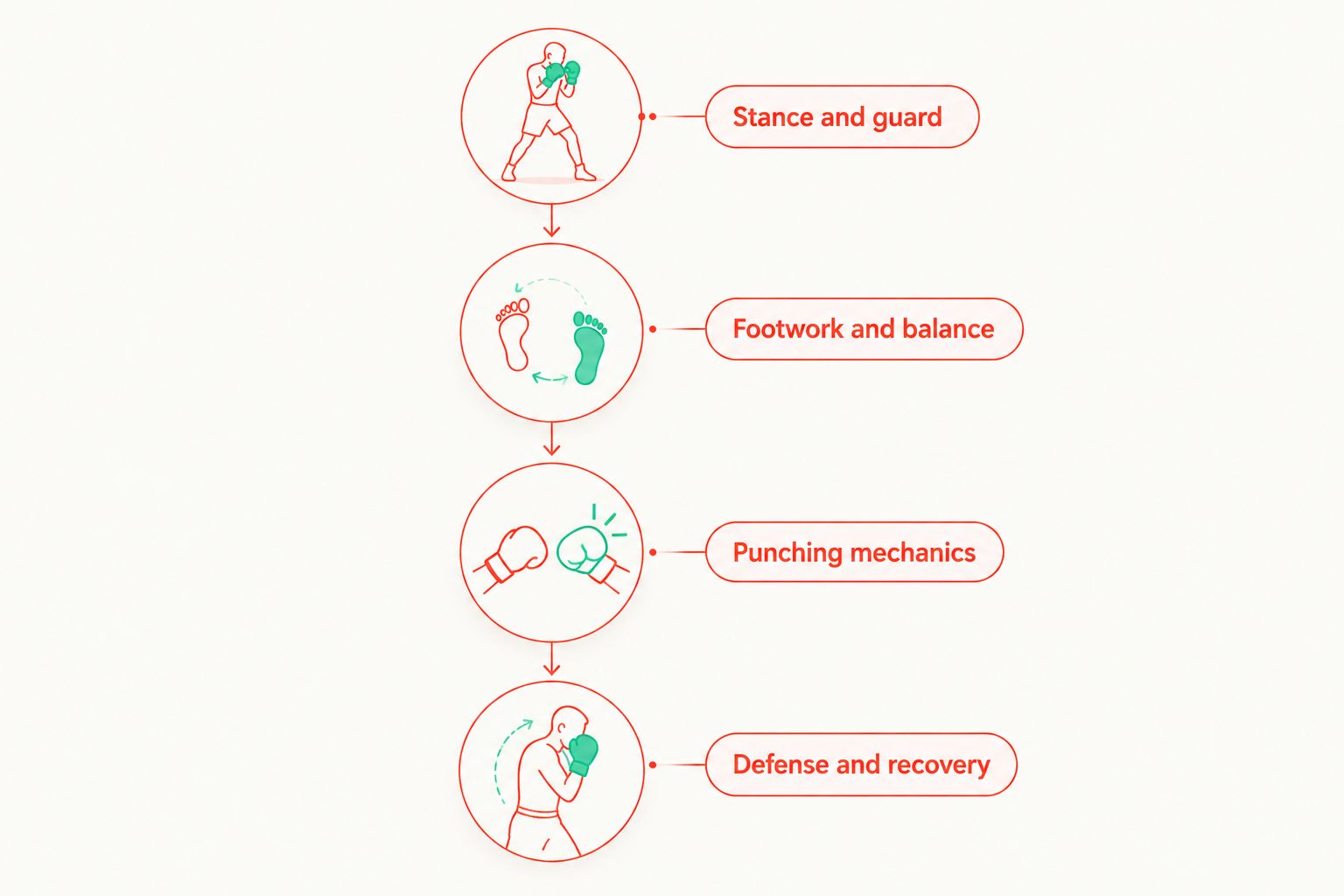
A sensible beginner teaching sequence looks like this:
- Explain your goals. Say whether you want to learn technique, improve conditioning, or eventually explore competition.
- Establish stance. Learn where your feet and hands belong before adding speed or power.
- Practice footwork. Work on moving without losing balance or crossing your feet.
- Introduce punching mechanics. Learn how a punch starts, travels, and returns to guard.
- Add defense. Practice controlled defensive movements before trying to combine everything at speed.
This is a sequence to discuss with a prospective coach, not a promised lesson plan. For the practical preparation side, use the guide to preparing for your first boxing lesson.
Why this matters
Waiting until you feel experienced enough reverses the purpose of coaching. You hire an instructor to learn the skills you do not yet have, including the details that are difficult to spot while practicing alone.
A punch can look convincing while leaving you off balance. A fast combination can hide a dropped guard. Early instruction gives you a way to judge technique beyond speed, effort, or how hard you hit.
You also need to separate your goals. Learning real boxing mechanics, improving fitness, and preparing to compete overlap, but they are not the same assignment. Tell your coach which matters most so the instruction has a clear direction.
What should a beginner learn before complicated combinations?
Start with movements you can repeat deliberately. Adding more punches does not solve an unstable stance or a hand that fails to return to guard.
Stance and guard
Your stance gives you a base for moving, punching, and defending. Ask the coach to explain foot placement, knee position, weight distribution, and where your hands should return after a punch.
Do not judge the stance only while standing still. Move forward, backward, and sideways under instruction, then check whether you can recover your starting position without stumbling or bringing your feet together.
Footwork and balance
Footwork is more than moving quickly. You need to maintain a usable stance while changing position.
Ask for a clear correction when your feet cross, your steps become too large, or your upper body moves ahead of your base. A useful drill gives you something specific to notice and correct, rather than simply telling you to move faster.
Punching mechanics
The 4 basic punch types are the jab, cross, hook, and uppercut. Knowing those names is not a prerequisite; learning how to perform them is part of beginner instruction.
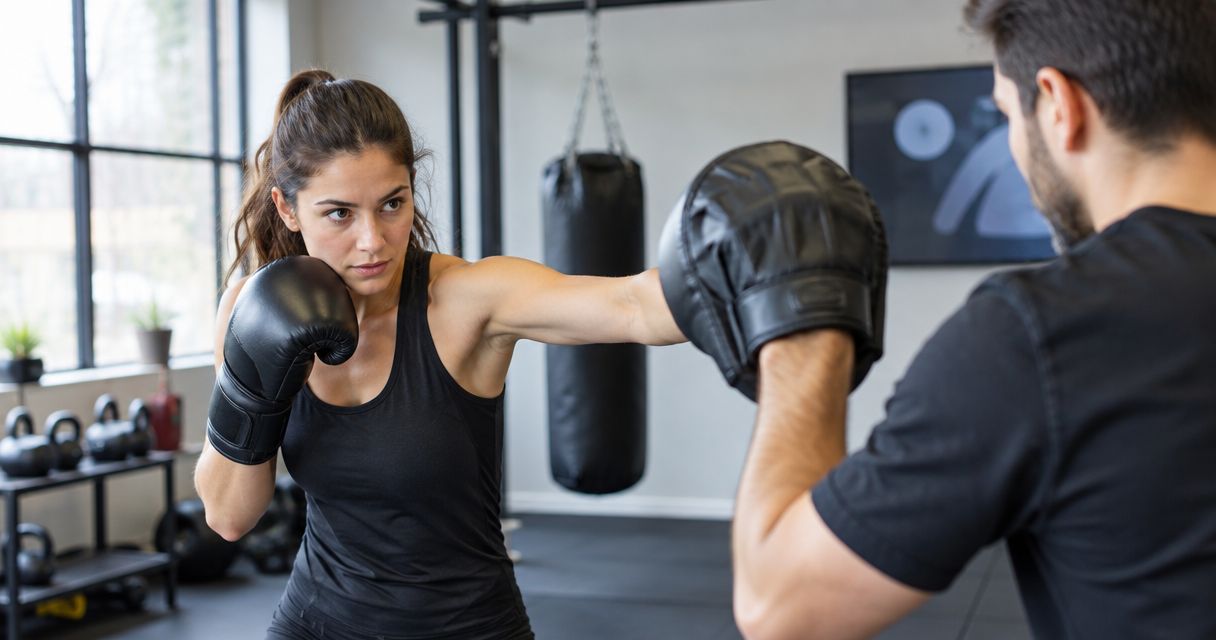
Work on controlled delivery and a return to guard before chasing power. Ask the coach to explain what your feet, hips, shoulders, and hands should do together. A punch is not just an arm movement.
Defense and recovery
Defense belongs in beginner training, but it does not require someone to hit you. A coach can introduce guard position, slipping mechanics, and controlled movement without live contact.
Practice finishing each action in a position from which you can move again. If you throw a punch and need to reset your entire body before doing anything else, slow the drill down and address the movement.
Which private boxing lesson format fits a beginner?
Choose the format that lets your coach observe and correct your movement. Both live virtual lessons and in-person instruction can include beginner technique work, but they do not offer identical hands-on experiences.
Use this comparison when choosing your starting format in 2026:
| Format | Best for | What it supports | Limitation to consider |
|---|---|---|---|
| Live virtual private lessons | Beginners who want instruction at home | Real-time observation, demonstrations, and verbal corrections | Camera framing affects what the coach can see; the coach cannot physically hold mitts for you |
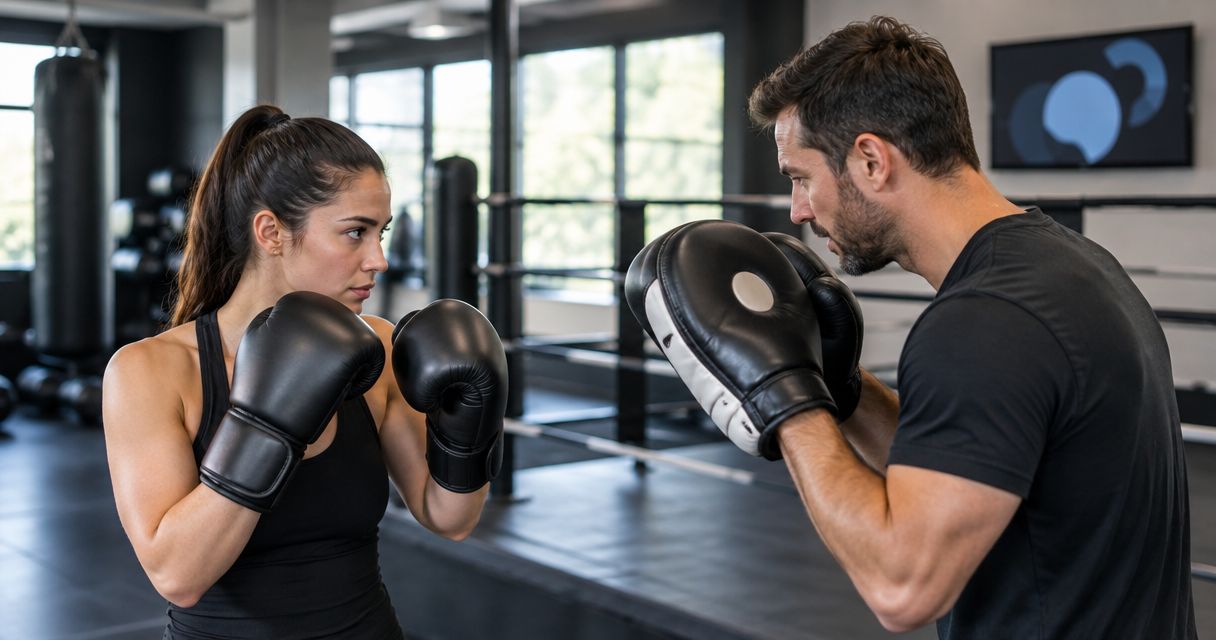
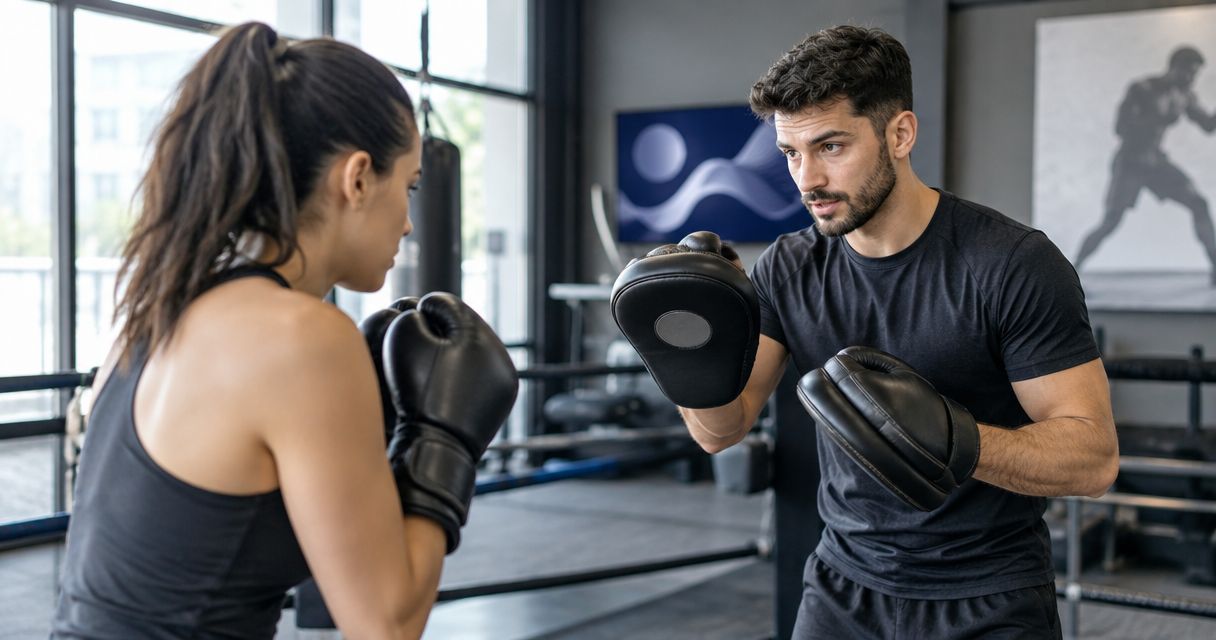
| In-person private lessons | Beginners who want direct observation and hands-on mitt work | Technique instruction with the coach physically present | You need a suitable meeting arrangement and training space |
| Small-group private training | Beginners who want to learn alongside others | Shared instruction and practice with a coach | Coaching attention is shared rather than exclusively yours |
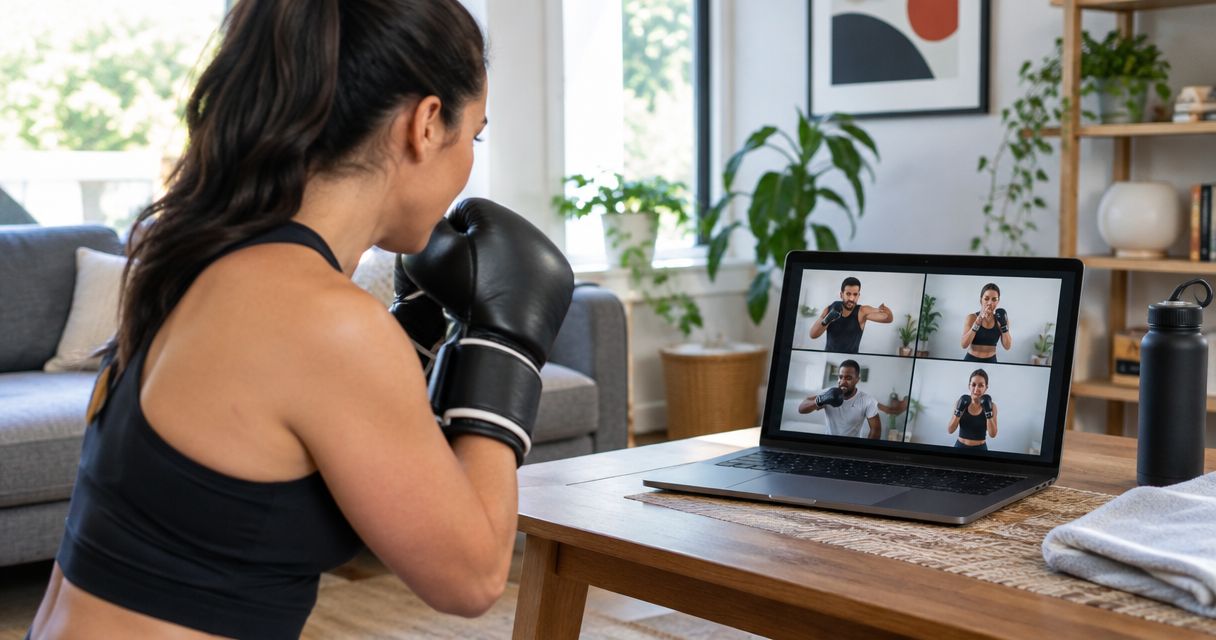
For virtual coaching, place the camera so the coach can see your feet as well as your upper body. A close-up of your gloves hides the stance and footwork that make the punch possible.
For in-person coaching, discuss the training setting before the lesson. A home, garage, or outdoor space needs clear footing and room for the movements the coach plans to teach. Do not assume that owning a heavy bag makes the space suitable.
A beginner option: live private instruction and a basics program
Better Through Boxing is best for beginners seeking live private boxing coaching rather than a prerecorded workout. Coach Chris Persaud teaches beginners through competitors, with real-time Zoom lessons worldwide and in-person coaching in Somerset County, New Jersey, and surrounding areas.
The business also offers the 6-week Zoom-based Better Through Boxing Basics Program. Its stated instruction areas include boxing mechanics, footwork, defense, strategy, and conditioning.
The advantage for a beginner is access to a live coach rather than instruction you can only watch. The limitation of the virtual format remains physical: a remote coach cannot hold mitts for you or inspect movement from every angle simultaneously.
When considering the program in 2026, ask how instruction matches your current ability and what you should practice between lessons. A 6-week program describes its duration, not a guarantee of mastery or readiness to compete.
Why beginner instruction varies
Beginner coaching should reflect your starting point, not force everyone through the same workout. Discuss these factors before choosing lessons:
- Previous training: Fitness-boxing classes, solo practice, and technical boxing lessons provide different backgrounds. Explain what you actually practiced.
- Training goal: Technique, conditioning, and competition preparation require different emphasis. Name your priority rather than asking for everything at once.
- Movement control: Stance, balance, and coordination affect which drills you can perform deliberately. Ask the coach to assess these before increasing complexity.
- Conditioning: Being new to boxing and being new to exercise are separate issues. Describe your current activity so the coach can discuss an appropriate starting approach.
- Lesson format: Zoom instruction depends on a useful camera view; in-person coaching allows physical mitt work. Choose based on the instruction you want.
- Practice setting: Homes, garages, and outdoor spaces differ. Confirm that your space works for the planned movements rather than guessing from appearance.
These factors explain why another beginner's session is not a reliable template for yours. You are hiring for instruction that fits your movement and goals.
How do you recognize a coach who welcomes beginners?
Ask for an explanation, not reassurance alone. A coach who says beginners are welcome should also be able to describe how instruction starts and how corrections are delivered.
Use these questions when evaluating a private boxing coach in 2026:
- What do you teach someone who has never boxed?
- How do you check stance and footwork?
- How do you adjust a drill when the student cannot perform it correctly?
- Can lessons focus on technique without sparring?
- What should the student practice between sessions?
- What equipment should the student have before starting?
Listen for concrete teaching terms: stance, guard, footwork, punching mechanics, slipping, and pivoting. An answer centered only on sweating, intensity, or calorie burn does not explain how you will learn boxing.
Choose clear correction over complicated combinations. A coach should be able to identify what needs changing and give you an action you can attempt immediately.
You should also understand the boundaries of the lesson. Clarify whether the session is non-contact technique, conditioning, mitt work, or something else. Do not let the word boxing substitute for an explanation of what you will actually do.
Do you need to get fit before hiring a boxing coach?
No, you do not need to complete a separate fitness program before seeking beginner boxing instruction. Tell the coach about your current activity level so you can discuss how technique and conditioning will fit together.
Being tired does not prove that a movement is correct. If fatigue makes you lose your stance or stop returning your hands to guard, ask to reduce the pace and restore control.
You do not need to earn instruction by exhausting yourself first. If you have an injury, symptoms, or a medical restriction affecting exercise, seek appropriate medical advice and tell the coach before training.
Can you start private boxing lessons without a heavy bag?
Yes, beginner boxing instruction can start without a heavy bag. Stance, footwork, guard, and shadowboxing do not require bag contact.
A bag gives you something to strike; it does not explain whether your feet, hips, and hands are coordinated correctly. Ask what equipment your chosen lesson requires before buying anything.
Does hiring a private boxing coach mean you have to spar?
No, hiring a private boxing coach does not mean you have to spar. Technique instruction, conditioning, and controlled drills are distinct from exchanging punches with another person.
State your preference clearly: you want non-contact instruction, you are undecided about sparring, or you eventually want to discuss competition. Sparring readiness is a separate coaching decision, not a reward automatically earned by attending lessons.
What should you do before the first lesson?
Prepare useful information, not a performance. Your coach needs to understand your starting point more than see a combination you memorized yesterday.
Describe your previous exercise and boxing experience accurately. Mention relevant injuries or restrictions, and ask what clothing and equipment the planned session requires. For virtual instruction, test your connection and camera view before the lesson begins.
Then write down your main goal in plain language. Wanting to learn stance and defense is clearer than wanting to get good at boxing. Wanting technical instruction without contact is clearer than assuming the coach already knows your preference.
Before committing to a training plan in 2026, make sure you understand how progress will be discussed. Ask which movements you will practice independently and how the coach will check them next time. Leave with a specific practice task, not just a memory of working hard.
FAQ
Do you need experience before hiring a boxing coach?
No, you do not need experience before hiring a boxing coach. Choose a coach who teaches beginners and can explain how lessons introduce stance, footwork, punching mechanics, and defense.
Is private boxing coaching suitable for a complete beginner?
Yes, private boxing coaching is suitable for a complete beginner when the coach offers beginner instruction. Better Through Boxing provides live private boxing coaching for beginners through competitors.
Can I learn boxing through live Zoom lessons as a beginner?
Yes, live Zoom lessons can teach beginner stance, footwork, punching mechanics, and defensive movement. The coach needs a clear view of your body, and remote instruction does not provide physical mitt holding by the coach.
Do I need to know the basic punches before my first lesson?
No, you do not need to know the basic punches before your first lesson. The 4 basic punch types are the jab, cross, hook, and uppercut; beginner instruction teaches their mechanics rather than assuming you know them.
Do I have to spar during private boxing lessons?
No, private boxing lessons do not have to include sparring. Tell the coach you want non-contact instruction and confirm the planned activities before starting.
How long is the Better Through Boxing Basics Program?
The Better Through Boxing Basics Program is a 6-week Zoom-based program. That duration does not guarantee mastery, competition readiness, or readiness to spar.
Do I need a heavy bag to start learning boxing?
No, stance, footwork, guard, and shadowboxing can be practiced without a heavy bag. Confirm the equipment requirements for your chosen lessons before purchasing gear.
One last thing
Your most useful beginner question is not whether you looked like a boxer. Ask: What should I change on the next repetition?
That question turns a broad judgment into a teachable action. A clearer stance, a controlled step, or a hand returning to guard gives you something to practice—and gives your coach something specific to check.