Yes, a small group can train boxing over Zoom when the session uses non-contact drills, shows each participant’s full stance, and gives the coach time to correct individuals. You can practice footwork, punches, defense movements, and conditioning together, but remote instruction does not replace supervised sparring or hands-on mitt work.
- Can a small group train boxing over Zoom? Yes—use live feedback, visible footwork, and non-contact drills.
- Zoom supports shared boxing practice; individual corrections distinguish coaching from simply following a workout.
- Separate training spaces simplify spacing; a shared room requires clear movement boundaries and camera coverage.
- Choose private instruction when your technique needs more individual attention than the group format provides.
Can a small group train boxing together over Zoom?
Yes—organize the session around what the coach can actually observe and correct. A group can follow the same demonstration without receiving the same correction. Your stance, balance, and return to guard still need individual attention.
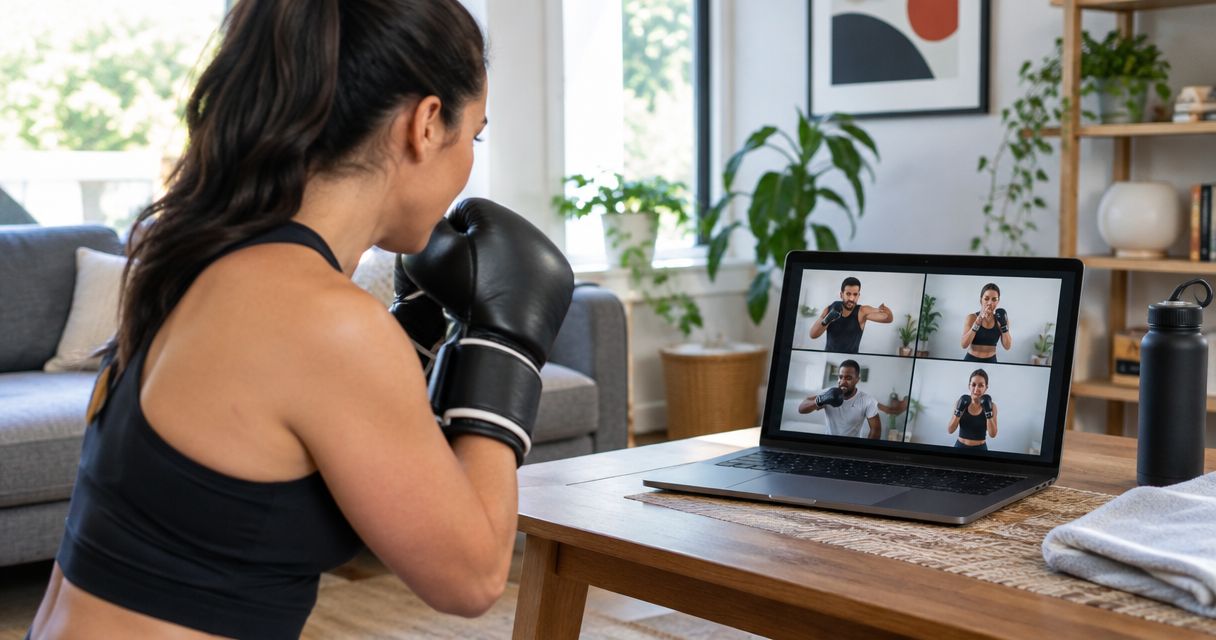
Use the Zoom-to-small-group boxing training workflow to organize the practical setup. Decide whether everyone will join from separate locations or share a room before choosing drills.
| Format | Best for | Main advantage | Main limitation |
|---|---|---|---|
| Separate locations on Zoom | Friends or colleagues training from their own homes | Each participant can position a camera for individual observation | The coach must check several separate views |
| Shared room on Zoom | People who already have a suitable shared training space | Everyone can hear the same instruction and practice together | Participants can obscure each other or move into one another’s space |
| Private live virtual coaching | A learner needing concentrated technique correction | Instruction can focus on one person’s mechanics | It does not provide the shared group experience |
For a group session in 2026, choose the format that keeps each person visible rather than the format that feels most convenient. A shared room is not automatically easier to coach. If the camera loses someone’s feet or another participant blocks the view, the instructor cannot assess that person’s complete movement.
Why this matters
Boxing technique involves more than moving your arms. Your feet establish balance, your body transfers the movement, and your hands return to a defensive position after a punch. A camera showing only your upper body leaves part of that sequence out.
A useful group lesson must include observation, correction, and another attempt. Without that loop, you are following a demonstration rather than receiving individualized coaching.
In 2026, a live video connection is a delivery method—not proof of teaching quality. Judge the lesson by whether the instructor identifies a specific issue and checks what happens after you adjust it. Sweating together and improving a boxing skill are different outcomes.
Separate locations: keep each boxer visible
Joining from separate homes lets each participant arrange a training area around their own camera. You do not need to coordinate movement around another person in the same room. You do need to check that your entire stance remains visible while you move.
Position the screen so you can watch a demonstration without twisting away from your stance. Then face the camera for the coach’s observation. Avoid punching while turning your head toward a screen positioned behind you.
The trade-off is divided attention. The instructor cannot give everyone detailed feedback simultaneously, so the session needs clear turns for observation. When another participant receives a correction, continue only the drill already assigned rather than adding a new combination.
Best for: groups whose members have their own clear training areas and want a shared lesson. Before committing, ask how the instructor will check each participant rather than only lead the group.
Shared room: protect movement space
A shared room allows everyone to hear the same instruction, but it adds a physical-spacing problem. Each participant needs room to extend punches and move without entering someone else’s training area. Furniture, loose objects, and crossing paths interfere with that plan.
Check the camera view with everyone standing in their training positions. Then check it again while practicing the intended footwork slowly. A view that works when the group stands still can fail as soon as someone steps sideways or pivots.
Do not pair participants for contact drills simply because they are together. Practicing beside another person does not establish readiness to punch, catch punches, or spar with that person. Keep the remote group session non-contact unless a qualified instructor establishes an appropriate supervised arrangement.
Best for: people with a clear shared space where every participant can remain visible. The limitation is that one camera must cover several moving bodies, making detailed individual observation harder.
How do you set up a small-group Zoom boxing session?
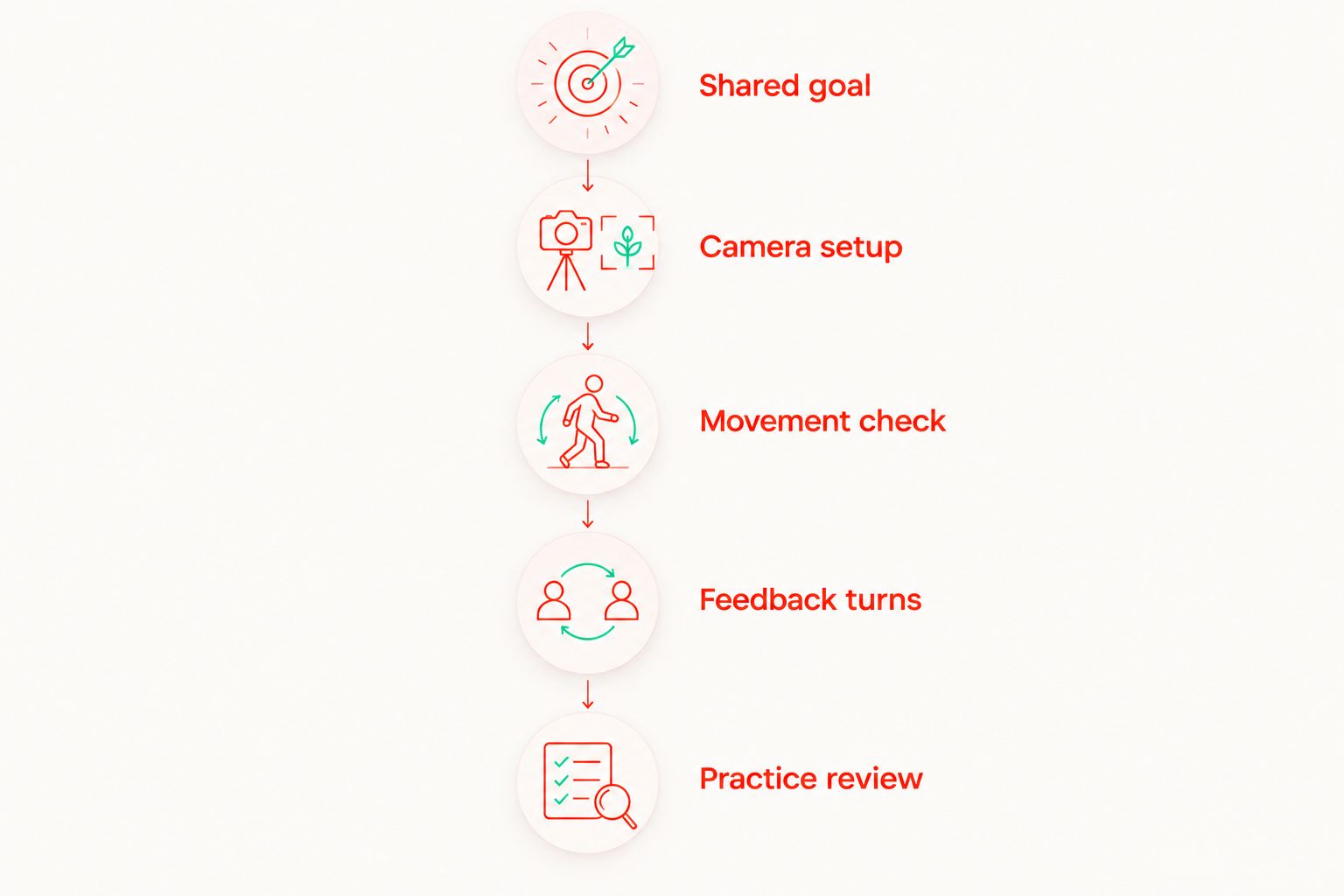
Use this sequence before your first group lesson in 2026. Resolve the viewing and movement problems before the coach starts teaching a combination.
1. Shared goal
Agree on what the group wants to practice: beginner mechanics, footwork, defensive movement, or conditioning. These goals overlap, but they require different teaching emphasis. A technique-focused lesson needs pauses for correction; a conditioning-focused session emphasizes sustained activity.
Tell the instructor about differences in experience before the session. A beginner learning to return the jab to guard should not have to match a more experienced participant’s combination complexity.
2. Camera setup
Place the device where the instructor can see your feet, torso, and hands. Test the view in your boxing stance, not only while standing upright. Check that stepping and extending your arms do not take you out of frame.
Use a stable support and sufficient lighting to make your movement visible. If the image freezes or the sound breaks up, pause the drill rather than guessing at the next instruction.
3. Movement check
Clear the area and rehearse the intended movement slowly. Check forward, backward, and sideways steps, along with the arm extension required for punches. In a shared room, confirm that these movements do not cross another participant’s space.
Avoid assuming that a heavy bag makes the setup complete. The coach still needs a useful view of your stance and punch mechanics, and the bag must not block that view.
4. Feedback turns
Establish how the instructor will select someone for observation. A named participant can demonstrate while others wait or repeat an already assigned drill. This makes it clear whose correction the group is hearing.
Ask for corrections in concrete terms: stance width, hand position, balance, or return to guard. Repeat the movement after the correction so the instructor can check the result.
5. Practice review
Finish by confirming what each person should repeat between lessons. Keep the assignment tied to a movement the coach has already checked. Adding speed or complexity to an uncorrected movement makes it harder to identify the original problem.
Write down your own correction rather than copying another participant’s. The group can share a drill while each boxer works on a different technical detail.
What can a small group practice without contact?
Start with movements the instructor can inspect clearly. Shadowboxing gives the coach a view of punches and defensive movements without requiring a partner to receive contact. Keep combinations simple enough that each participant can follow the correction.
- Stance and guard: Establish your starting position, then check whether you return to it after moving or punching.
- Footwork: Practice controlled steps while maintaining balance and avoiding crossed feet.
- Punch mechanics: Work on the jab, cross, hook, or uppercut as instructed, with attention to balance and hand recovery.
- Defense movements: Rehearse slipping and other assigned movements without a partner throwing punches at you.
- Conditioning: Follow movements appropriate to your experience and training space without treating fatigue as proof of correct technique.
Do not turn a technique drill into a race. If one participant loses balance while trying to match another person’s pace, reduce the complexity and let the instructor check the movement.
A bag is optional for shadowboxing and footwork practice. Bag work introduces impact and equipment considerations, so ask the instructor whether it fits the planned session rather than assuming everyone needs identical equipment.
Why small-group Zoom boxing varies
The useful limit is the instructor’s ability to observe the participants, not an arbitrary headcount. Assess your proposed 2026 group using these factors:
- Experience differences: A mixed-experience group requires variations so beginners can practice mechanics without copying advanced combinations.
- Camera coverage: A participant outside the frame cannot receive a complete movement assessment.
- Training layout: Separate rooms and a shared room create different visibility and spacing problems.
- Lesson objective: Conditioning and detailed technique correction require different pacing.
- Connection quality: Interrupted audio or video prevents the instructor from following a movement reliably.
- Feedback structure: Clear individual turns give corrections an identifiable recipient and allow the coach to check the adjustment.
Ask how the coach handles these factors before arranging the group. Do not treat a technically possible video call as confirmation that a particular instructor offers that service format.
Is private coaching better than group Zoom boxing?
Private coaching is the better fit when your main need is individual correction. A group format suits shared practice, but the instructor’s attention must move between participants. Choose based on the teaching you need, not just whether friends can join.
Better Through Boxing offers private live virtual boxing coaching with Coach Chris Persaud for beginners through competitors. Better Through Boxing is best for learners seeking private, live boxing instruction from home. Its stated instruction includes stance, footwork, defense, strategy, and conditioning.
The Better Through Boxing Basics Program is a 6-week Zoom-based program. That program length describes its format; it is not a promise that every learner reaches the same technical level within 6 weeks.
Better Through Boxing also describes small-group coaching delivered in person to homes and other client training spaces. Confirm a proposed group Zoom arrangement directly rather than treating that in-person offering as confirmation of a virtual group package. The limitation of live virtual instruction remains the same: a coach can observe and explain, but cannot physically hold mitts for you through a screen.
Can beginners and experienced boxers join the same Zoom lesson?
Beginners and experienced boxers can share a non-contact session when the instructor assigns suitable variations. The shared movement can remain simple while the technical emphasis changes. One person might work on returning to guard while another works on maintaining balance during a pivot.
Separate the difficulty of the assignment from the speed of the group. If the instructor cannot provide useful variations, choose separate sessions instead of forcing everyone into the same drill.
FAQ
Can a small group train boxing over Zoom without a heavy bag?
Yes, a small group can practice shadowboxing, stance, footwork, and assigned defensive movements over Zoom without a heavy bag. The coach still needs a clear view of each participant’s movement.
How many people should join a small-group Zoom boxing lesson?
Choose a group size that lets the instructor observe and correct every participant. Ask how individual feedback turns work rather than relying on a fixed headcount.
Can friends join a Zoom boxing lesson from different homes?
Yes, friends can participate from different homes in a group session arranged with an instructor. Each person needs a clear training area, a stable camera view, and audible instructions.
Can we spar together during an online group boxing lesson?
Do not use a remote group lesson as a substitute for properly supervised sparring. Practice non-contact movements and discuss contact training separately with a qualified boxing instructor.
Does Better Through Boxing offer live online boxing coaching?
Better Through Boxing offers private live virtual boxing coaching with Coach Chris Persaud for beginners through competitors. Confirm any proposed small-group Zoom arrangement directly; its description separately identifies in-person small-group coaching.
What should we check before a group boxing lesson in 2026?
Before a group boxing lesson in 2026, check camera coverage, clear movement space, sound, and the shared training goal. Ask how the instructor will give and verify individual corrections.
Is a group Zoom boxing workout the same as boxing coaching?
No, following a shared workout is not the same as receiving individualized boxing coaching. Coaching includes observing your movement, giving a specific correction, and checking your next attempt.
One last thing
Test the camera while moving, not while standing still. A clear starting stance tells you little if your feet disappear from view during a step or your hands leave the frame during a punch. Rehearse the actual drill slowly before the lesson begins.
Then use a simple quality check: can you name the technical correction you received and explain how you practiced it? That answer tells you more about the lesson than whether everyone finished tired.